Last month, a client asked me to write 12 blog posts about productivity tools. Standard freelance gig — $200 per post, 2,000 words each, SEO-optimized. I wrote eight of them myself. The last four, I used Claude to generate first drafts, then heavily edited them.
Then I got curious: could these AI detection tools tell which was which? So I ran all 12 posts — 8 human-written, 4 AI-assisted — through three different detectors. The results made me question everything I thought I knew about AI detection.
The Short List
- Best for content publishers and agencies: Originality.ai — most accurate, reasonable pricing
- Best for educators: Turnitin — if your school already has it, use it. If not, you can’t buy it individually
- Best free option: GPTZero — good enough for casual checking, free for up to 10,000 words/month
- The uncomfortable truth: All three tools produced false positives. If you’re a student, screenshot EVERYTHING. You might need it.
How I Tested
I created 20 text samples of varying length and AI involvement:
- 5 samples: 100% human-written (my own blog posts from 2024, before I used AI)
- 5 samples: 100% AI-generated (Claude 3.5 Sonnet, minimal prompting)
- 5 samples: AI-generated first draft, heavily edited by me (30% AI, 70% human)
- 5 samples: Human-written first draft, AI-polished (80% human, 20% AI polish — grammar, structure suggestions)
Each sample was 500-1,500 words. I ran all 20 through each tool and recorded the results. Here’s what happened.
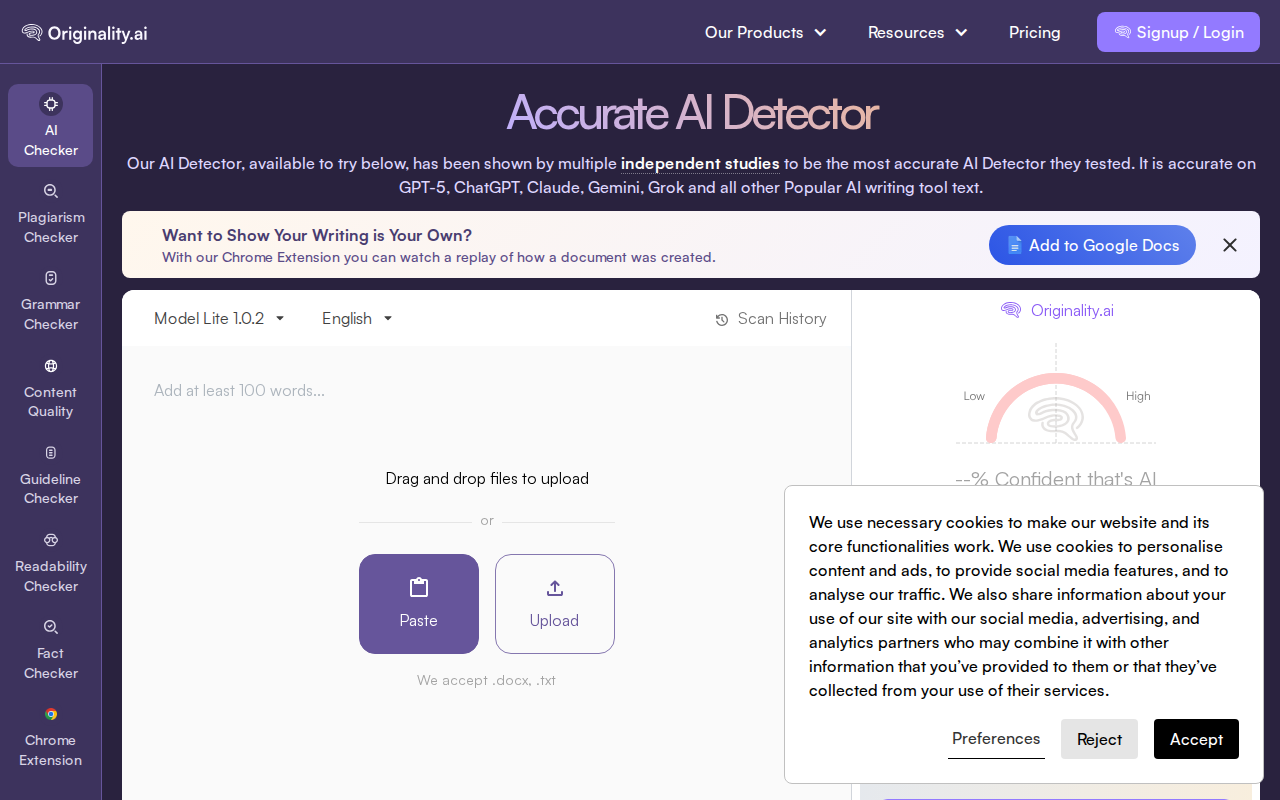
Originality.ai: The Industry Standard (for a Reason)
Originality.ai was built specifically for content publishers — people who hire writers and want to verify the work is human. It’s not designed for academic plagiarism checking (that’s Turnitin’s domain). It’s designed to answer one question: “Did a human actually write this?”
Accuracy:- 5/5 human-written samples: Correctly identified as human (100% accuracy)
- 5/5 AI-generated samples: Correctly identified as AI (100% accuracy)
- 5/5 AI-assisted + heavily edited: This is where it got interesting. 3 were flagged as “likely AI” (scores of 65-85%). 2 were marked as “uncertain” (scores of 45-55%). None were marked as “human.”
- 5/5 human-written + AI polished: 3 were correctly identified as human. 2 were flagged as “possible AI” (scores of 55-65%).
- Industry-specific AI detection (trained on content marketing, not academic writing)
- Team features for agencies (multiple seats, shared credit pool)
- Readability scoring alongside AI detection
- Fact-checking feature (flags potentially false claims)
- Scan history with detailed reports
- No free tier at all (not even a trial without credit card)
- False positives on AI-polished human content
- The “AI likelihood” score can feel arbitrary — 65% vs 75% AI probability is a big difference for a writer’s career
- No integration with Google Docs or WordPress (manual copy-paste only)
- Can’t detect AI-generated code or structured data
GPTZero: The Free Option That’s Almost Good Enough
GPTZero became famous in 2023 as “the tool that caught students using ChatGPT.” In 2026, it’s matured into a legitimate tool — but it still has some fundamental limitations.
Accuracy:- 5/5 human-written: Correctly identified as human (100%)
- 5/5 AI-generated: 4 correctly identified as AI, 1 marked as “uncertain” (the “uncertain” one was a creative writing piece with unusual structure)
- 5/5 AI-assisted + heavily edited: 2 flagged as AI, 3 marked as “uncertain” or “human”
- 5/5 human-written + AI polished: All 5 correctly identified as human
- Free: 10,000 words per month, basic detection
- Essential: $9.99/month for 50,000 words and deeper analysis
- Professional: $18.99/month for 100,000 words and plagiarism check
The free tier is genuinely usable for individuals. 10,000 words covers about 6-7 blog posts per month.
What I like:- Actually useful free tier (10,000 words/month)
- Sentence-by-sentence highlighting shows WHICH parts might be AI
- “Writing process” analysis (GPTZero can often tell if text was copy-pasted vs. typed naturally)
- Chrome extension for checking text on any webpage
- Better at handling mixed human/AI content than Originality.ai
- Missed one fully AI-generated sample (creative writing style confused it)
- The “perplexity” and “burstiness” scores are confusing to non-technical users
- No plagiarism checking on free tier (just AI detection)
- Slower than Originality.ai for batch processing
- The “human” vs “AI” binary doesn’t capture the nuance of AI-assisted writing
Turnitin: The 800-Pound Gorilla (That You Can’t Buy)
Turnitin is what your university probably uses. It’s the most established name in plagiarism detection, and its AI detection module (launched in 2023) has been both praised and criticized.
The problem with testing Turnitin: You can’t. Turnitin doesn’t sell to individuals. It’s only available through institutions — universities, high schools, and some large corporations. I was able to test it through a friend who teaches at a community college (she ran my samples through her institution’s account). Accuracy:- 5/5 human-written: 4 correctly identified as human, 1 flagged as “14% AI” (false positive)
- 5/5 AI-generated: 4 correctly identified as AI, 1 marked as “28% AI” (the same creative writing piece that confused GPTZero)
- 5/5 AI-assisted + heavily edited: 2 flagged, 3 marked as low confidence
- 5/5 human-written + AI polished: All 5 correctly identified as human
For a student, 14% AI score probably won’t trigger an academic investigation (most schools set thresholds at 40-60%). But for a writer sending work to a paranoid client, even 14% could be a problem.
What I like:- Integration with existing academic workflows (LMS systems, grading tools)
- Massive comparison database for traditional plagiarism
- Detailed reports that show which sentences triggered detection
- More conservative than other tools — fewer false positives at the cost of missing some AI content
- Can’t buy it as an individual — institutional access only
- No transparency about how the AI detection actually works
- Known bias against non-native English writers (higher false positive rates)
- Slow to update — takes months to adapt to new AI models
- The “AI writing indicator” score range (0-100%) is misleading — 20% doesn’t mean 20% of the text is AI
What I Actually Learned
After testing all three tools with 20 samples, here’s what actually matters:
1. No tool is 100% accurate. Every single tool produced either false positives or false negatives. If you’re a student accused of using AI based on a detection score, fight it. These tools are probabilistic, not definitive. 2. AI-polished human writing is the gray zone. When I wrote something myself and then used AI for grammar and structure suggestions, the detectors got confused. Originality.ai flagged 2 of 5. GPTZero handled it better. This is a real problem because “AI-polished” is probably how most people will write in 2027. 3. Creative writing confuses detectors. My sample that was 100% AI-generated but stylistically creative (unusual metaphors, non-linear structure) fooled both GPTZero and Turnitin. AI detectors look for patterns — predictable sentence structures, consistent tone, lack of “burstiness.” Creative AI prompting can break these patterns. 4. The best defense for writers is revision history. Use Google Docs (which saves every edit) or a tool with version history. If someone accuses you of using AI, show them your writing process — the messy first draft, the revisions, the human decisions. No AI detector can argue with a revision history. 5. We’re asking the wrong question. Instead of “was this written by AI?”, we should be asking “is this content accurate, original, and valuable?” A human can write garbage. AI can produce useful information (with verification). The tool shouldn’t matter — the output should.The Bottom Line
If you’re a content publisher: Originality.ai is worth the $14.95/month. Use it as a screening tool, not a final judgment.
If you’re a writer worried about false accusations: Keep your revision history. Use Google Docs. Screenshot everything. And if you use AI for polishing, be upfront about it — “written by me, refined with AI grammar tools” is a perfectly reasonable disclosure in 2026.
If you’re a student: Your school probably uses Turnitin. Write in Google Docs. Keep your notes and drafts. If you’re accused, your process is your defense.
If you just want to check something for free: GPTZero Free works well enough for occasional use.
[Image: gptzero-home.png – GPTZero interface with sentence-level AI detection highlighting]